The Secret Behind Xpeng IRON's Powerful "Brain"
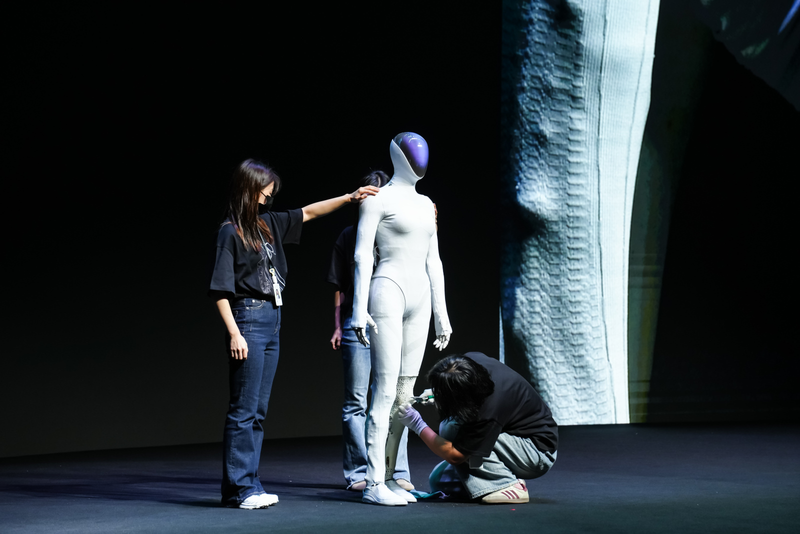
From XPeng Tech Day video
At the 2025 Tech Day, the Xpeng IRON humanoid robot's fluid catwalk not only brought down the house but also sent shockwaves through the industry, showcasing a near-instinctive level of coordination and intelligence. To demonstrate that no real person was walking on stage, the staff deliberately made a point of showing this. The secret to this feat lies not merely in precise mechanical actuation but, more crucially, in an unprecedentedly powerful intelligent system housed within its “head”—a “digital brain” composed of supercomputing power, revolutionary algorithms, and a highly coordinated “large and small brain” architecture. The power of this brain is not the victory of a single technology, but a meticulously orchestrated systemic triumph—a “trinity” of advancements.
Cornerstone One: Raw Computing Power
Any advanced intelligence requires a powerful physical foundation. The IRON robot's "thinking" speed stems from its self-developed “Turing” AI chips. These three chips together form a computing hub with a computational power of 2250 TOPS.
What does this number mean? Let's draw a clear comparison: mainstream high-performance autonomous driving chips typically offer computational power in the range of a few hundred TOPS, while IRON's power is several times that. This is equivalent to packing the brains of multiple smart cars into a single robot's head. Such immense computational power is necessary to handle a task far more complex than autonomous driving: full-dimensional environmental perception and real-time whole-body motion control. The physical environment a robot operates in is open and unstructured. It needs to simultaneously process multiple streams of information—visual, depth, force, auditory—from dozens of sensors around its body. The 2250 TOPS of computing power ensure it can:
1) Process high-dimensional data in real-time: Understand visual scenes from cameras, 3D spaces constructed by LiDAR, and force feedback from joint motors without delay.
2) Execute multiple tasks in parallel: It can conduct natural language conversations with humans while planning its walking path and simultaneously performing delicate operations like opening doors or handing objects with its arms. This ability to “multitask” relies on the support of supercomputing power.
3) Support the operation of complex models: It provides the hardware foundation needed for the smooth operation of behemoths like the second-generation VLA large model, making "thinking" itself fast and efficient.
In essence, the extreme computing power provided by the self-developed chipset is the "powerful heart" that allows the IRON's intelligent brain to operate at high speed.
Cornerstone Two: The Second-Generation VLA Large Model
If computing power is the brain's “horsepower”, then the algorithm is its "driving skill." The soul infused into IRON by Xpeng is its breakthrough second-generation Visual-Language-Action (VLA) large model. The revolutionary nature of this technology lies in achieving a crucial "short circuit"—it removes the intermediate step of “language translation”, enabling end-to-end direct generation from visual signals to action commands.
The traditional AI workflow is: “see a cup -> recognize 'this is a cup' -> generate the command 'pick up the cup' -> drive the arm.”This process is lengthy and unnatural, like a command system that constantly requires translation. The second-generation VLA model, however, allows the AI to learn "intuitive reactions": the moment it “sees” the cup, it directly generates the neural signals that control the arm muscles.
This end-to-end mapping from "vision to action" brings a qualitative leap:
1) Reduced intermediate steps: The decision-making and execution chain is significantly shortened, making the robot's reaction time closer to biological instinct.
2) More human-like behavior: Its actions are no longer like rigid programs but resemble fluent, natural behaviors based on a holistic understanding of the scene. Adapting to ground irregularities while walking or fine-tuning hand position when reaching for an object thus becomes smoother and more precise.
3) Possesses generalization capability: It no longer relies solely on pre-programmed fixed scenarios. Faced with an unseen object or a completely new environment layout, it can analogize, reason, and attempt actions based on its vast existing knowledge, demonstrating preliminary "inference" intelligence.
Cornerstone Three: Sophisticated Coordination of the “Advanced Large and Small Brain”
A truly powerful brain requires not only fast calculation and intuitive reaction but also division of labor and collaboration akin to the human "cerebral cortex and cerebellum. Xpeng has designed an advanced “large and small brain” collaborative architecture composed of VLT, VLA, and VLM.
VLM: Visual Language Model – The “cerebral cortex” responsible for “Perception & Cognition”. It is the system's knowledge base and comprehension center, tasked with interpreting images, understanding language, and answering questions like “What is this?” and “Where is it?” It enables IRON to recognize objects and understand the semantics of human commands.
VLT: Visual Language Thinking – The “central nervous system” responsible for “Planning & Decision-making.” It thinks, plans, and reasons based on the perceptions from the VLM, answering questions like “ ]What should I do now?” and “What's the next step?” For example, integrating the visual information “the ground is slippery” with the command “walk to the other side”, it decides on the strategy “need to walk carefully and slowly”.
VLA: Visual Language Action – The “cerebellum” responsible for “Execution & Control”. It receives decisions from the VLT and translates them into specific movement commands for every joint, every “muscle” of the robot's body, controlling the precise coordination of numerous degrees of freedom to ultimately achieve stable, balanced, and accurate motion output.
These three form a perfect closed loop: VLM “sees” the world, VLT thinks of a plan, VLA executes the action. It is this highly specialized division of labor and seamless collaboration that fuses powerful raw computing power with advanced algorithms into an organic whole, allowing the IRON robot to evolve from a powerful computer into a physical entity possessing “action intelligence”.
Therefore, the powerful intelligence of the Xpeng IRON robot is a victory of systems engineering. This is not merely a technological breakthrough for one robot; it is Xpeng's declaration of its stride into the world of “Physical AI”. It demonstrates that artificial intelligence is no longer just a virtual presence behind screens but is now acquiring a “body” and a “brain” capable of autonomously perceiving, thinking, and acting upon our real world.
